Pallet Jack vs Forklift: Understanding the Basics
When it comes to moving heavy loads in warehouses, factories, or retail environments, pallet jacks and forklifts are two of the most commonly used pieces of equipment. While they might serve the same ultimate purpose—transporting goods—they differ significantly in design, capacity, functionality, and cost. Knowing the difference between forklift and pallet jack is essential for choosing the right tool for your specific needs.
What is a Pallet Jack?
A pallet jack—also known as a pallet truck or pump truck—is one of the simplest tools in material handling. But don’t let “simple” fool you. It’s powerful. With it, workers can move heavy pallets without breaking their backs or relying on big, expensive machines like forklifts.
The idea is straightforward: slide the forks under a pallet, lift it just enough to clear the floor, and roll. That’s it. Suddenly, what seemed heavy becomes manageable. Warehouses, retail shops, factories, and loading docks all rely on pallet jacks for everyday moves.
Types of Pallet Jacks
There are two main kinds:
- Manual pallet jacks: The classic version. You pump the handle, lift the pallet, and steer by hand. No power—just muscle and hydraulics.
- Electric pallet jacks: A step up. Battery-powered motors handle both lifting and driving. They’re faster, easier, and perfect when you’re moving heavy loads all day long.
Key Features
- Load capacity: Most hold 3,000–5,500 lbs. Some heavy-duty models can carry even more.
- Reach: Unlike forklifts, pallet jacks don’t raise pallets high. They keep loads low—just off the floor—for easy rolling.
- Operation: Manual = pump and push. Electric = press a button and glide.
- Design: Compact and nimble. They slip through tight aisles and crowded storage areas with ease.
- Surfaces: Best for flat, smooth floors like warehouse concrete. Some have tougher wheels for rough ground.
Why Use a Pallet Jack?
- Cost savings: Cheaper than forklifts—both to buy and maintain.
- Easy to use: Training is minimal, especially for manual versions.
- Versatile: Works everywhere—warehouses, retail backrooms, factories, delivery trucks.
- Maneuverability: Great in tight spaces where forklifts just won’t fit.
- Ergonomics: Electric models save energy and reduce fatigue, which matters in high-volume jobs.
The pallet jack may not look impressive. No towering lift, no roaring engine. But it’s the quiet workhorse of material handling. Affordable. Reliable. Versatile. Without it, daily operations in countless industries would grind to a halt.
What is a Forklift?
A forklift is a powerful workhorse. Small in size, but strong. It’s built to lift, move, and carry heavy loads that people can’t manage on their own. Unlike a hand truck or pallet jack, a forklift uses hydraulics, counterweights, and steel forks to move things not just across the ground—but up into the air. That’s why it’s everywhere: warehouses, construction sites, shipping yards. Modern business runs on forklifts.
Key Features of Forklifts
- Load capacity: Forklifts come in all sizes. Some handle around 3,000 pounds. Others? More than 50,000. A small warehouse doesn’t need a monster machine. A shipping port does.
- Lift height: Many models stretch their masts several meters high. This makes stacking pallets on tall shelves or pulling goods from the top rack fast and easy.
- Design variety: There’s a forklift for almost every job. Counterbalance models are the “everyday” choice. Reach trucks rule narrow aisles. Rough-terrain forklifts? They thrive on dirt, gravel, and uneven ground.
- Power source: Options include electric (clean, quiet, great indoors), propane (a balance of cost and muscle), or diesel/gas (big power, built for outdoors).
Why Forklifts Matter
- Reach new heights: Manual tools can’t stack pallets 20 feet up. Forklifts can.
- Move heavy loads: From small crates to giant containers, they handle weight that would take teams of workers. That means less strain and more speed.
- Work anywhere: Indoors or outdoors. Smooth floors or rugged terrain. There’s a forklift built for each environment.
Forklifts aren’t just machines. They’re problem solvers. They make jobs safer, faster, and more efficient. Without them? Modern supply chains would grind to a halt.
The Core Difference Between Forklift and Pallet Jack
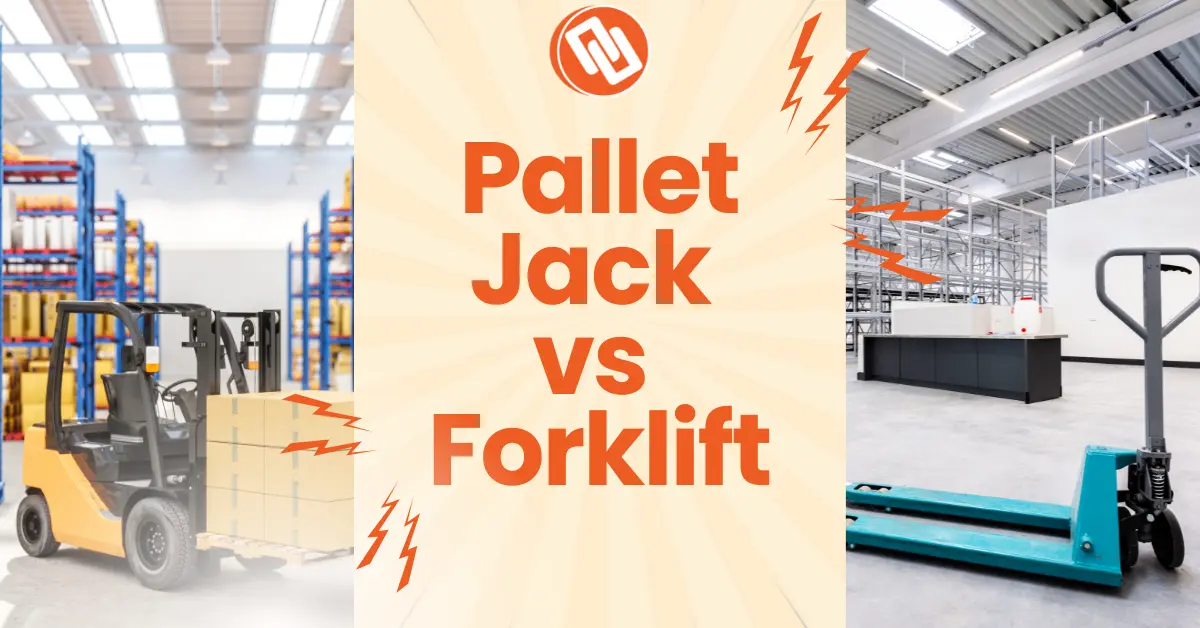
When comparing forklifts and pallet jacks, the gap is clear. It’s all about how much they can lift—and how they move.
- Pallet Jack: Think small. Think simple. A pallet jack is the go-to tool for moving loads across the floor. Quick. Easy. Affordable. Perfect for short trips inside a warehouse or from a dock to storage. But here’s the catch: it barely lifts. Just a few inches. That’s it. No stacking. No shelving. Just speed and maneuverability at ground level.
- Forklift: Now flip the picture. A forklift is the muscle. Heavy-duty. Built for real lifting—several feet into the air. It can stack pallets high, reach shelving, and carry much more weight than a jack ever could. Forklifts cover longer distances, roll over rough ground, and handle tough jobs in warehouses, plants, or even outdoors. They’re powerful, versatile, and built for more than just floor work.
Pallet jacks? Light, cheap, and best for ground moves.
Forklifts? Strong, versatile, and made for height and heavy loads.
In short: low-lift vs. high-lift. That’s the difference.
In Which Cases Do You Use a Forklift Instead of a Pallet Jack?
While both pallet jacks and forklifts are valuable material-handling tools, there are specific situations where a forklift clearly outperforms a pallet jack. Understanding these scenarios helps businesses maximize productivity, safety, and long-term cost efficiency.
1. When You Need to Lift Loads to Height
A forklift can lift. Not just a little—high. Racks, mezzanines, truck beds—no problem. That vertical reach saves space and keeps warehouses organized.
A pallet jack? Only inches. Good for moving pallets across the floor. Not for stacking, not for high storage. If your job involves height, forklifts win.
Example: A warehouse with tall racks for seasonal stock depends on forklifts to keep aisles clear and shelves full.
2. When Handling Heavier Loads
Pallet jacks have limits. Usually 5,000–6,000 lbs. Push more, and you risk breaking gear—or worse, hurting someone.
Forklifts? They’re built for strength. Many handle 10,000 lbs easily. Some go far beyond. Industries that move steel, bricks, or other dense loads trust forklifts because failure isn’t an option.
Example: A yard moving heavy steel beams relies on forklifts to lift safely, again and again.
3. When Operating Over Longer Distances or Uneven Terrain
Forklifts move. Fast. Across warehouses. Between buildings. Over gravel, ramps, uneven ground. Their tires, suspension, and engines are designed for it.
Pallet jacks? Indoor tools. Smooth floors only. Struggle on bumps. Useless outside.
Example: A factory that shifts goods between separate buildings counts on forklifts to cross outdoor paths quickly and safely.
4. When Time Efficiency Is a Priority
Every minute matters in busy operations. A forklift moves more, faster. One trip replaces many pallet jack runs. Workers save time, companies save money.
Distribution centers love them. Faster dock-to-shelf, shelf-to-truck. Pallet jacks can’t keep up.
Example: A shipping hub moving thousands of packages daily cuts hours off workload by using forklifts for bulk loads.
5. When Safety and Stability Are Critical
Forklifts are built with safety in mind—counterbalances, overhead guards, operator cabins. Loads stay secure, workers stay protected.
Pallet jacks leave balance and control in the operator’s hands. Risk rises with fragile or unstable items.
Example: Moving sensitive medical devices is safer with a forklift—stable lift, enclosed driver, reduced chance of damage.
Pallet Jack vs Forklift: Side-by-Side Comparison
Choosing between a pallet jack and a forklift ultimately comes down to your operational needs, budget, and workspace conditions. Here’s a quick breakdown to help you decide:
| Feature | Pallet Jack | Forklift |
| Load Capacity | 3,000–6,000 lbs | 3,000–50,000+ lbs |
| Lift Height | A few inches off the ground | Several meters, depending on model |
| Best Use | Short-distance, ground-level transport | Lifting, stacking, and transporting over longer distances |
| Cost | Low purchase and maintenance costs | Higher upfront and upkeep costs |
| Training | Minimal | Requires certification and training |
| Maneuverability | Excellent in tight spaces | Larger turning radius, but versatile across terrains |
Final Thoughts
If you only need to move goods short distances at ground level, a pallet jack is a cost-effective, easy-to-use option. However, if your workflow involves lifting heavy loads to height, covering larger distances, or operating on uneven terrain, a forklift is the better investment.
Both tools have their place in material handling, and in many cases, businesses benefit from having both—using pallet jacks for quick, low-level moves and forklifts for heavy-duty lifting and stacking.
Understanding the difference between forklift and pallet jack ensures you choose equipment that maximizes efficiency, safety, and ROI. Whether you’re outfitting a new warehouse or upgrading your current fleet, selecting the right tool is critical to keeping your operations running smoothly.
For expert advice, top-quality equipment, and practical solutions tailored to your needs, visit our website today and discover how we can help you move your business forward.